


Beautifully engraved RARE Specimen $1,000 Bond Certificate from the County of Dade, Florida dated in 1946. This historic document was printed by Columbian Bank Note Company and has an ornate border around it with a vignette of the Florida State Seal. This item is over 60 years old. 20 coupons attached on top. 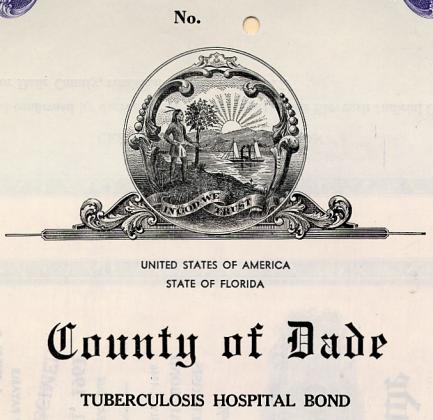
Certificate Vignette Tuberculosis has been present in humans since antiquity, as the origins of the disease are in the first domestication of cattle (which also gave humanity viral poxes). Skeletal remains show prehistoric humans (4000 BC) had TB and tubercular decay has been found in the spines of Egyptian mummies from 3000-2400 BC. There were references to TB in India around 2000 BC, and indications of lung scarring identical to that of modern-day TB sufferers in preserved bodies (such as mummies) suggests that TB was present in The Americas from about 2000 BC Phthisis is a Greek term for consumption. Around 460 BC, Hippocrates identified phthisis as the most widespread disease of the times which was almost always fatal. Due to the variety of its symptoms, TB was not identified as a unified disease until the 1820s and was not named tuberculosis until 1839 by J. L. Schönlein. During the years 1838-1845, Dr. John Croghan, the owner of Mammoth Cave, brought a number of tuberculosis sufferers into the cave in hopes of curing the disease with the constant temperature and purity of the cave air. The first TB sanatorium opened in 1859 in Poland, with another opening in the United States in 1885. The bacillus-causing tuberculosis, Mycobacterium tuberculosis, was described on March 24, 1882 by Robert Koch. He received the Nobel Prize in physiology or medicine in 1905 for this discovery. Koch did not believe that bovine (cattle) and human tuberculosis were similar, which held back the recognition of infected milk as a source of infection. Later, this source was eliminated by pasteurization. Koch announced a glycerine extract of the tubercle bacilli as a "remedy" for tuberculosis in 1890, calling it tuberculin. It was not effective, but was later adapted by von Pirquet for a test for pre-symptomatic tuberculosis. The first genuine success in immunizing against tuberculosis developed from attenuated bovine strain tuberculosis by Albert Calmette and Camille Guerin in 1906 was BCG (Bacillus of Calmette and Guerin). It was first used on humans on July 18, 1921 in France, although national arrogance prevented its widespread use in either the USA, Great Britain, or Germany until after World War II. Tuberculosis caused the most widespread public concern in the 19th and early 20th centuries as the endemic disease of the urban poor. In 1815 England one in four deaths were of consumption; by 1918 one in six deaths in France were still caused by TB. After the establishment in the 1880s that the disease was contagious, TB was made a notifiable disease in Britain; there were campaigns to stop spitting in public places, and the infected poor were "encouraged" to enter sanatoria that rather resembled prisons. Whatever the purported benefits of the fresh air and labor in the sanatoria, 75% of those who entered were dead within five years (1908). In the United States, concern about the spread of tuberculosis played a role in the movement to prohibit public spitting except into spittoons. In Europe, deaths from TB fell from 500 out of 100,000 in 1850 to 50 out of 100,000 by 1950. Improvements in public health were reducing tuberculosis even before the arrival of antibiotics, although the disease's significance was still such that when the Medical Research Council was formed in Britain in 1913 its first project was tuberculosis. It was not until 1946 with the development of the antibiotic streptomycin that treatment rather than prevention became a possibility. Prior to then only surgical intervention was possible as supposed treatment (other than sanatoria), including the pneumothorax technique: collapsing an infected lung to "rest" it and allow lesions to heal, which was an accomplished technique but was of little benefit and was discontinued after 1946. Hopes that the disease could be completely eliminated have been dashed since the rise of drug-resistant strains in the 1980s. For example, TB cases in Britain, numbering around 50,000 in 1955, had fallen to around 5,500 in 1987, but in 2001 there were over 7,000 confirmed cases. Due to the elimination of public health facilities in New York in the 1970s, there was a resurgence in the 1980s. The number of those failing to complete their course of drugs was very high. NY had to cope with more than 20,000 "unnecessary" TB-patients with many multi-drug resistant strains (i.e., resistant to, at least, both Rifampin and Isoniazid). The resurgence of tuberculosis resulted in the declaration of a global health emergency by the World Health Organization in 1993. In 2003, by disabling a set of genes, researchers accidentally created a more lethal and rapidly reproducing strain of tuberculosis bacteria. Christmas Seals was started in 1904 in Denmark as a way to raise money for tuberculosis programs. It expanded to the United States and Canada in 1907-08 to help the National Tuberculosis Association, later called the American Lung Association. During the Industrial Revolution, tuberculosis was more commonly thought of as vampirism. When one member of a family died from it, the other members that were infected would lose their health slowly. People believed that the cause of this was the original victim was draining the life from his/her family members. To cure this, people would dig up the body of what they thought was the vampire, open the chest and burn the heart, sometimes with the rest of the body. Furthermore, people who had TB exhibited symptoms similar to what people considered vampire traits (and may be where much of the common mythology of the vampire comes from). People with TB often had symptoms such as red, swollen eyes (which also creates a sensitivity to bright light), pale skin and would cough blood (which people often figured needed to be replenished because of the loss in this manner, so they figured the only way to get blood back was by sucking blood). History from Wikipedia and Encyberpedia.
About Specimens Specimen Certificates are actual certificates that have never been issued. They were usually kept by the printers in their permanent archives as their only example of a particular certificate. Sometimes you will see a hand stamp on the certificate that says "Do not remove from file". Specimens were also used to show prospective clients different types of certificate designs that were available. Specimen certificates are usually much scarcer than issued certificates. In fact, many times they are the only way to get a certificate for a particular company because the issued certificates were redeemed and destroyed. In a few instances, Specimen certificates we made for a company but were never used because a different design was chosen by the company. These certificates are normally stamped "Specimen" or they have small holes spelling the word specimen. Most of the time they don't have a serial number, or they have a serial number of 00000. This is an exciting sector of the hobby that grown in popularity and realized nice appreciation in value over the past several years.
Certificate Vignette
About Specimens Specimen Certificates are actual certificates that have never been issued. They were usually kept by the printers in their permanent archives as their only example of a particular certificate. Sometimes you will see a hand stamp on the certificate that says "Do not remove from file". Specimens were also used to show prospective clients different types of certificate designs that were available. Specimen certificates are usually much scarcer than issued certificates. In fact, many times they are the only way to get a certificate for a particular company because the issued certificates were redeemed and destroyed. In a few instances, Specimen certificates we made for a company but were never used because a different design was chosen by the company. These certificates are normally stamped "Specimen" or they have small holes spelling the word specimen. Most of the time they don't have a serial number, or they have a serial number of 00000. This is an exciting sector of the hobby that grown in popularity and realized nice appreciation in value over the past several years.


