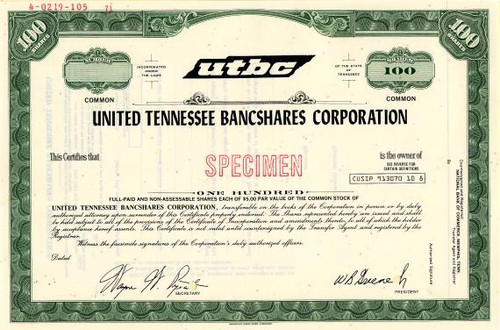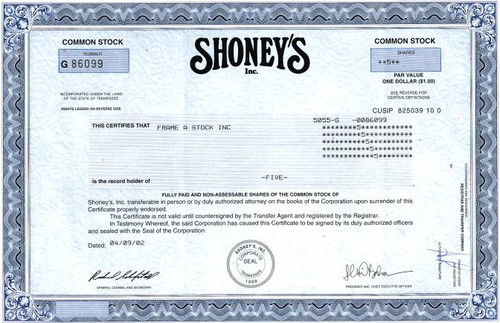


Beautifully engraved certificate from the Tennessee Valley Authority issued no later than 1987. This historic document was printed by the Security-Columbian Banknote Company and has an ornate border around it with a vignette of an allegorical woman in front of the dam and power plant. This item has the printed signatures of the Company's General Manager and Secretary and is over 18 years old. 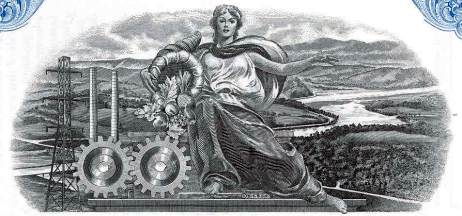
Certificate Vignette President Franklin Roosevelt needed innovative solutions if the New Deal was to lift the nation out of the depths of the Great Depression. And TVA was one of his most innovative ideas. Roosevelt envisioned TVA as a totally different kind of agency. He asked Congress to create "a corporation clothed with the power of government but possessed of the flexibility and initiative of a private enterprise." On May 18, 1933, Congress passed the TVA Act (PDF file, 175 kb, requires Adobe Acrobat Reader). President Franklin D. Roosevelt signs the TVA Act on May 18, 1933. The president is surrounded by various members of Congress from the TVA region, and at his left shoulder is Senator George Norris of Nebraska, after whom Norris Dam is named. Right from the start, TVA established a unique problem-solving approach to fulfilling its mission-integrated resource management. Each issue TVA faced--whether it was power production, navigation, flood control, malaria prevention, reforestation, or erosion control--was studied in its broadest context. TVA weighed each issue in relation to the others. From this beginning, TVA has held fast to its strategy of integrated solutions, even as the issues changed over the years. TVA's First Board of Directors was charged with the task of implementing President Roosevelt's ambitious plans for the Tennessee Valley. Shown in about 1934 are, from left to right, Director Harcourt A. Morgan, Chairman Arthur E. Morgan, and Director David E. Lilienthal. 1930s Even by Depression standards, the Tennessee Valley was in sad shape in 1933. Much of the land had been farmed too hard for too long, eroding and depleting the soil. Crop yields had fallen along with farm incomes. The best timber had been cut. TVA developed fertilizers, taught farmers how to improve crop yields, and helped replant forests, control forest fires, and improve habitat for wildlife and fish. The most dramatic change in Valley life came from the electricity generated by TVA dams. Electric lights and modern appliances made life easier and farms more productive. Electricity also drew industries into the region, providing desperately needed jobs. TVA built dams to harness the region's rivers. The dams controlled floods, improved navigation, and generated electricity. 1940s During World War II, the United States needed aluminum to build bombs and airplanes, and aluminum plants required electricity. To provide power for such critical war industries, TVA engaged in one of the largest hydropower construction programs ever undertaken in the United States. Early in 1942, when the effort reached its peak, 12 hydroelectric projects and a steam plant were under construction at the same time, and design and construction employment reached a total of 28,000. During World War II, Senator George W. Norris of Nebraska, known as the Father of TVA, said, "I have been everlastingly proud of the great contributions TVA has made, which cannot be fully revealed until peace returns to a tortured world." He is shown here visiting Norris Dam. 1950s By the end of the war, TVA had completed a 650-mile (1,050-kilometer) navigation channel the length of the Tennessee River and had become the nation's largest electricity supplier. Even so, the demand for electricity was outstripping TVA's capacity to produce power from hydroelectric dams. Political interference kept TVA from securing additional federal appropriations to build coal-fired plants, so it sought the authority to issue bonds. Congress passed legislation in 1959 to make the TVA power system self-financing, and from that point on it would pay its own way. 1960s The 1960s were years of unprecedented economic growth in the Tennessee Valley. Farms and forests were in better shape than they had been in generations. Electric rates were among the nation's lowest and stayed low as TVA brought larger, more efficient generating units into service. Expecting the Valley's electric power needs to continue to grow, TVA began building nuclear plants as a new source of economical power. A turbine runner is installed in the hydroelectric plant at TVA's Guntersville Dam in northern Alabama. 1970s and 1980s Significant changes occurred in the economy of the Tennessee Valley and the nation, prompted by an international oil embargo in 1973 and accelerating fuel costs later in the decade. The average cost of electricity in the Tennessee Valley increased fivefold from the early 1970s to the early 1980s. With energy demand dropping and construction costs rising, TVA canceled several nuclear plants, as did other utilities around the nation. Energy conservation became an economic necessity for homeowners and businesses alike, and TVA became a national leader in promoting energy conservation. To become more competitive, TVA began improving efficiency and productivity while cutting costs. By the late 1980s, TVA had stopped the rise in power rates and paved the way for a period of rate stability that would last for the next decade. 1990s As the electric-utility industry moves toward restructuring, TVA is preparing for competition. In recent years it has cut operating costs by nearly $800 million a year, reduced its workforce by more than half, increased the generating capacity of its plants, stopped building nuclear plants, and developed a plan to meet the energy needs of the Tennessee Valley through the year 2020. Browns Ferry Nuclear Plant in Athens, Alabama, has three boiling-water reactors, each with a generating capacity of more than 1,100 megawatts. In the summer of 1999, TVA's nuclear plants set new records for efficient operation and helped the corporation meet an all-time peak demand of 28,295 megawatts on July 30. Today, as the electric power industry restructures, TVA continues to provide its core product--wholesale electric power--competitively, efficiently and reliably. It sets a standard for public responsibility against which private companies can be measured. Although TVA's production costs were third-lowest among the nation's 25 largest electric utilities in 1997, according to Electric Light & Power magazine, it continues to look for new ways to reduce costs even more and improve efficiency. TVA is on track to align the cost of its power with future competitive rates, in accordance with its 10-year business plan. TVA also has initiated a Business Transformation program to further reduce costs, and is moving to more flexible contracts with its distributor customers to meet their needs in a competitive marketplace. In 1998 TVA unveiled a new clean-air strategy to reduce the pollutants that cause ozone and smog. The initiative will cut annual nitrogen-oxide emissions from TVA's coal-fired plants by approximately 170,000 tons a year. Modern equipment, representing an investment of $600 million, will help states and cities in the Tennessee Valley meet new, more stringent air-quality standards while providing greater flexibility for industrial and economic growth in the region. TVA earlier invested more than $2 billion to reduce sulfur-dioxide and nitrogen-oxide emissions. In short, TVA continues to strengthen its position as an energy leader in price, reliability, efficiency, and environmental stewardship as it helps lead the utility industry into the 21st century.
Certificate Vignette