 | | | Croton Aqueduct (Croton Dam) signed by Samuel Farwell - New York 1839 | Historically important document(Payment Receipt) from the Water Commissioners of the City of New York signed in 1839. This early document was issued to confirm payment to Samuel Farwell for work performed in section number sixty eight on the Croton Aqueduct. Samuel Farwell hand signed the document. Over 168 years old.
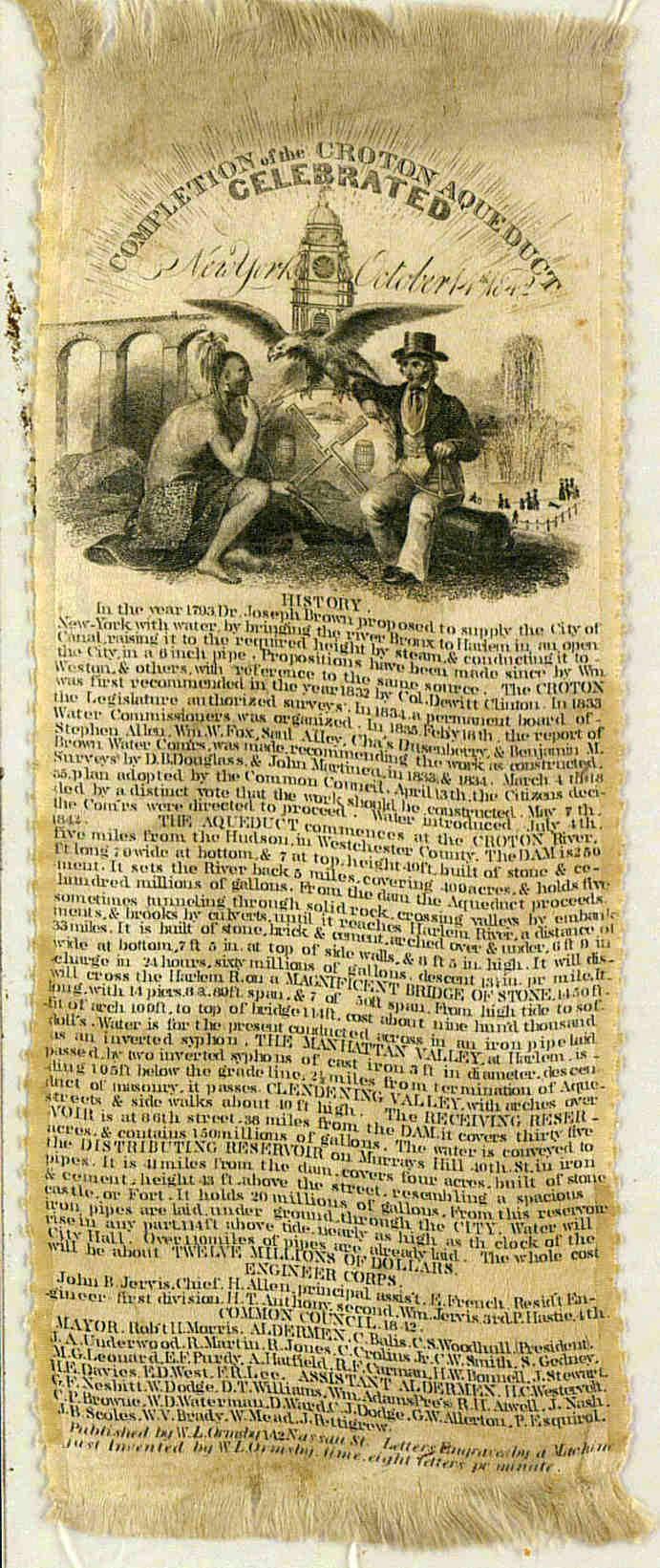
Westchester County Historical Society has the above Croton Aqueduct Souvenir dated 1842 celebrating the dam completion - Shown for illustrative purposes
The Croton Aqueduct was a large, complicated water system that was engineered between 1837 and 1842 to provide New York City with a steady supply of clean water. Before the aqueduct system, New Yorkers got their water from cisterns, wells, natural springs, and other bodies of water. But the rapid population growth that took place during the nineteenth century was accompanied by a number of terrifying fires that destroyed large parts of the city, whose buildings were mainly made of wood. There was also an increased demand for water for use in industry. To make matters worse, the existing water supply had become polluted and unsanitary, and contributed to an increase in disease and such epidemics as cholera and yellow fever. As a result, the city badly needed a fresh supply of water. The aqueduct was an intricate engineering project. Iron pipe encased in brick masonry was laid from the Croton Dam in northern Westchester County. It traveled over the High Bridge (the oldest of New York's great bridges at the time) that spanned the Harlem River at 173rd Street. It then went down the west side of Manhattan and into the Receiving Reservoir, located in the area then known as "Yorkville," between 79th and 86th streets and Sixth and Seventh Avenues. The Receiving Reservoir looked like a huge rectangular fortress. Water flowed from the Receiving Reservoir to the Distributing Reservoir (also known as the Croton Reservoir), a similar fortification located on the site of what is now the New York Public Library at Fifth Avenue between 40th and 42nd streets. Clean water was distributed from there to homesand businesses in the lower parts of the city. The Receiving Reservoir was 1,826 feet long and 836 feet wide, and held up to 180 million gallons of water. Thirty-five million gallons flowed into it daily. The land on which the reservoir was built had been owned by the city and by two private citizens. The Aqueduct opened to great fanfare on October 14, 1842. The celebration culminated in a fountain of water that spouted to a height of fifty feet from the beautifully decorated Croton Fountain in City Hall Park. Joining in the festivities were President Tyler, former presidents John Quincy Adams and Martin van Buren, Governor William Seward, city officials, representatives from civic organizations and dignitaries from neighboring states. The Croton Reservoir continued to supply New York City with drinking water until 1940, when Commissioner of Parks and Recreation Robert Moses ordered it drained and filled to create the Great Lawn in Central Park. Samuel Farwell was a contractor born about 1800 and died in Saginaw, Michigan, 17 November 1875. He was a resident of Utica, New York, and was known throughout the United States for fifty years as a contractor for the building of public works. He began work on the Erie Canal in 1825, completed contracts for the slack water navigation in Lehigh River in 1835, the Croton aqueduct in 1838, and afterward constructed the Boston waterworks. Subsequently he engaged in railroad building, and executed extensive contracts for the New York and Erie railway, the Great Western railway of Canada, the Utica and Black River railroad, and the Flint and Pere Marquette railway, of which last he was vice president and the principal shareholder. He also built the Brooklyn waterworks. History from the New York Historical Society. See Stock Certificate Expert Bob Kerstein, CEO
Scripophily.com
on
CNBC with
Jane Wells discussing the Facebook IPO on 5/17/2012,
and
Inside Edition and the
Today Show on 4/13/2012
Subscribe to our New Free RSS New Products Feed in a Reader
Subscribe to Our New Product Additions Feed by Email
| WASHINGTON, DC -
Scripophily.com / Old Company Stock and Bond Research Service
recently acquired the
Old Stock & Bond Research
Archives from Herzog & Co., Inc.
The asset
purchase includes all archives, publishing rights and copyrights on
obsolete research reference material published by the Marvyn
Scudders Manuals, the Robert D. Fisher Manuals, and the Herzog &
Co., Inc. obsolete research services, which have been performed
continuously since 1880. John Herzog, President of Herzog &
Co., Inc. said “My wife, Diana, and I are very pleased with this
transfer to Scripophily.com, and know that Bob will continue his
excellent work and spearhead the digitizing and reorganizing of this
classic American research that we were always proud to have taken
part in continuing.” |
Scripophily.com / Old
Company Research Service,
successor to
all material published
by the Marvyn Scudders Manuals, the Robert D. Fisher Manuals, and the
Herzog & Co., Inc. obsolete research services, which have been performed
continuously since 1880, is the
leading provider of authentic stock certificates, autographs, and
old company stock research services. Our company was founded by Bob Kerstein,
CPA who is a member of the American Institute of
Certified Public Accountants, California Society of Certified Public Accountants, and the Virginia Society of Certified Public Accountants. We have been collecting and selling old stock and bond certificates
since 1990. Scripophily.com started operating on the Internet in January
1996 with the goal to promote the history of old companies and help educate everyone about the wonderful hobby of collecting stock
and bond certificates called Scripophily.
We will always maintain our founding commitment to customer satisfaction and the delivery of an educational product with an enjoyable shopping experience. Please
let us know how we may be of service to you. |
|

Scripophily has
been
fully tested by
Norton Safe Web
|
Note:
All Old Stock and Bond
Certificates are actual authentic certificates and are sold only as collectibles.
We do not sell reproductions and offer a lifetime guarantee to the
authenticity of everything we sell.
All Rights Reserved. © 1996 - 2012 Scripophily.com ©, Scripophily .net (tm), Wall Street History - Lost and Found (sm), Bob.com ©, ConfederateBonds.com, CSABonds.com, StockLedger.com, Occupy Wall Space (tm), Stock Research Professional, Old Company Research (tm), Old Stock Certificate Research, Old Stock Exchange ©, Gift of History (sm), Liberty Loans, Liberty Bonds, LibertyBonds.com,
Marvyn
Scudders Manuals, Robert D. Fisher Manuals,
Scripophily Exchange (tm), EBITDA.com., PSTA - Professional Scripophily
Traders Association, Stock Research Service, OldCompany.com, StockCalendar.com, PSTA.COM, Bob Kerstein, CPA, CGMA - The Old Stock Detective © and Encyberpedia ©. You may link to the site, but
please do not copy any images or information without our expressed written permission.
If you are publishing a book for educational purposes or with the press, please
contact us directly at 703-787-3552 for use of our content.
|
|

American Institute of
Certified Public Accountants

Virginia Society CPA's
Bob Kerstein, Member |

 |
|

American Numismatic Association
Securities and Exchange
Commission Historical Society
Society of Paper Money Collectors
Member |

Better Business
Bureau Member Rated A+ |
|
| |  |