

The South Fork Canal Company played a pivotal role in the development of Northern California’s water infrastructure during the mid-19th century. Established primarily to support the thriving hydraulic mining industry in El Dorado County, the company embarked on a monumental task of diverting water from the South Fork of the American River. By constructing an intricate network of wooden flumes and earthen ditches that traversed miles across rugged Sierra Nevada terrain, they provided the high-pressure water indispensable for miners to remove hillsides in their pursuit of gold. This engineering accomplishment not only propelled the local economy but also transformed the physical landscape, establishing a dependable water supply in a region characterized by seasonal extremes.
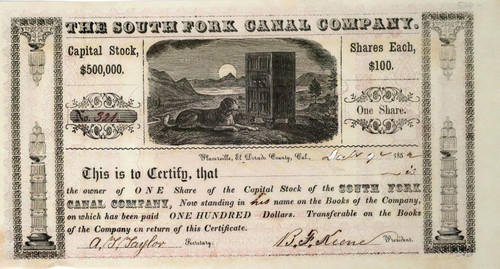
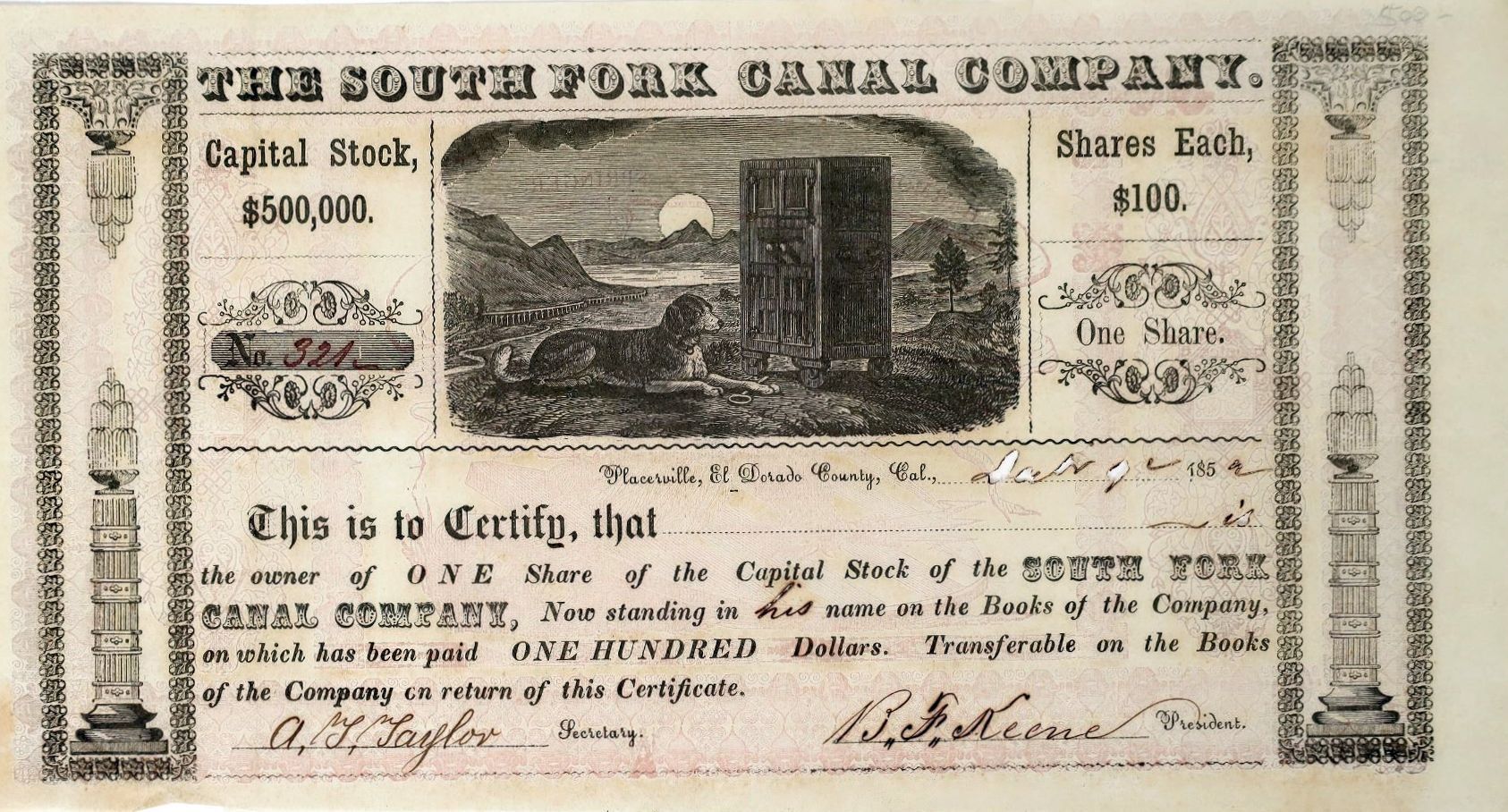
Browne (1868) reports a main ditch line of 34 miles carrying 600 inches of water 24 miles at a grade of 4.5 feet per mile from the south fork of the American River supplying Placerville and vicinity. Original cost was $500,000 but the value in 1868 had dropped to $50,000. There were 108 miles of lateral channels and three reservoirs: Silver Lake, Red, Lake, and Willow Valley, all of which held nearly 350 million cubic feet of water. They charged 25 cents per inch for mining and domestic use, and $7 per acre for vineyards. B.F. Keene was a physician, popular California Mother Lode politician and once president pro-term of the Senate. He died in 1856 while president of the State Medical Society. A.T. Taylor was a California pioneer and one of California's earliest historians and prolific writers. He came to California from China in Sept. 1848. Bancroft consulted with Taylor for his monumental work on the history of California. Ken Prag Collection
As the gold rush subsided and mining interests diminished, the company’s infrastructure underwent a transformation to cater to the growing agricultural and residential population. The canals that once served as monitors for gold extraction were eventually repurposed to irrigate orchards and provide potable water for developing townships such as Placerville.