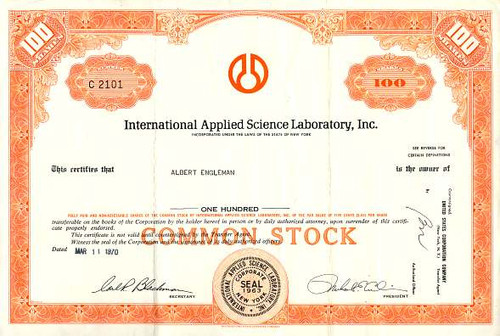


Beautifully engraved SPECIMEN certificate from the Baxter Travenol Laboratories, Inc. dated 1977. This historic document was printed by the Security-Columbian United States Banknote Company and has an ornate border around it with a vignette of an allegorical woman with a globe. This item has the printed signatures of the Company's President (William B. Graham ) and Secretary and is over 25 years old. 
Certificate Vignette 1931 The company is founded as the first manufacturer of commercially prepared intravenous solutions. 1933 During its first two years, the company distributed products manufactured by another company in Los Angeles owned by Dr. Don Baxter. But as demand grew in the Midwest, the need for a more central manufacturing base became apparent. In 1933, the company opened its first manufacturing facility in a renovated automobile showroom in Glenview, Illinois. There, six employees turned out the complete line of five solutions in glass containers. 1935 The young company prospered and its products earned a reputation for safety and effectiveness, giving physicians new confidence in intravenous therapy. In 1935, Dr. Ralph Falk purchased Dr. Baxter's interest in the company. He also developed an research-and-development function that was the beginning of the company's pioneering advances in medical technology. Strong commitment to R&D continues today as the key to the company's product development efforts. 1939 In 1939, the company, now named Baxter Laboratories, introduced the Transfuso-Vac container, the first sterile, vacuum-type blood collection and storage unit. Before this breakthrough product, blood could be stored for only a few hours; the new container allowed storage for up to 21 days, making blood banking practical for the first time. THE 1940s 1941 When World War II broke out, many of Baxter's blood-collection devices and 25 solutions were the only ones that met the specifications of the U.S. Armed Forces. Temporary plants opened to meet increased demand. However, at the end of the war, demand diminished and the company focused on its need for strong leadership to move the company forward. The Plasma-Vac container provides the first means of separating plasma from whole blood and storing it for future use. 1944 Early in the '40s, a Dutch physician named Willem Kolff began searching for a way to use dialysis, the process by which particles pass through a membrane, to treat patients with kidney failure. In 1944, his work resulted in the Kolff rotating drum kidney, the first machine to remove waste materials successfully from the blood through dialysis. Constructed of wood slats and a cellophane membrane, the Kolff artificial kidney required extensive setup and took over six hours to perform dialysis. 1945 A young patent lawyer named William B. Graham joined the company in 1945 as vice president and manager, and in 1953, succeeded founder Ralph Falk as chief executive officer (CEO). Baxter established one of the most outstanding growth records in American industry during Mr. Graham's tenure as CEO. In 1945, sales exceed $1.5 million. 1947 In 1947, the company moved from its Glenview plant to a larger, central base of operations in Morton Grove, Illinois. The move enabled the company to respond to developments in medical care during the '40s that would have a profound impact on Baxter in years to come: blood therapy and kidney dialysis. 1948 The end of World War II allowed application of emerging plastics technology to the task of storing human blood. In 1948, Dr. Carl Walter, a noted Boston surgeon and co-founder of Fenwal Laboratories, invented the non-breakable Blood-Pack plastic container. THE 1950s 1950 The company grew quickly and began increasing production capacity, as well as new products and international markets. The '50s ushered in a period of expansion: in 1950, the company opened its second US plant, in Cleveland, Mississippi. 1952 Baxter acquired Hyland Laboratories, the first US company to make human plasma commercially available. 1953 William B. Graham becomes president and chief executive officer, and Baxter begins 25 consecutive years of more than 20-percent annual earnings growth. 1954 The company expanded internationally with the opening of an office in Belgium. 1956 Seeking a medical company that would help develop his kidney dialysis machine (essentially made up of of orange juice cans and a washing machine), Dr. Willem Kolff found an ally in Mr. Graham, who was intrigued by the product and saw its possibilities. By 1956, Baxter medical engineers had improved the original construction and had meticulously built 184 working artificial kidneys. Baxter introduced the first commercially built artificial kidney, making life-saving dialysis possible for people with end-stage renal disease. However, the artificial kidney did not immediately receive widespread acceptance in the medical community. The company persevered and today provides products for hemodialysis, peritoneal dialysis (PD) and continuous ambulatory peritoneal dialysis (CAPD), as well as transplantation. 1959 Fenwal Laboratories was purchased in 1959. The unit's Blood-Pack plastic system for collection and processing of whole blood later led to Baxter's development of the Viaflex plastic IV bag, another major innovation in IV therapy. More recently, the technology was applied in the development of a flexible plastic delivery system for dialysis solutions for continuous ambulatory peritoneal dialysis (CAPD), another Baxter first. In the late '50s, Baxter formally established an international division to sell Baxter products around the world. Today, more than half of Baxter sales come from non-U.S. markets. Today, the company has 175 facilities in 50 countries around the world and Its products are used by patients and health-care professionals in more than 100 countries. THE 1960s The long-term relationship between Baxter and American Hospital Supply Corporation ended. American had been the primary distributor for Baxter products since the 1930s. For the first time, Baxter became committed to its own U.S.-based sales team. 1960 Edwards Laboratories, later to become a division of Baxter, introduces the first implantable heart valve in the United States. Over the next few years, Edwards also introduced the industry's first "balloon" catheters for therapeutic use: the Swan-Ganz cardiac-monitoring catheter and the Fogarty catheter for removing clots from peripheral blood vessels. 1961 Baxter's performance had made it increasingly attractive to investors, and on May 15, 1961 Baxter stock began trading on the New York Stock Exchange. During the '60s , Travenol (from inTRAVENous sOLutions) was added to the company name and the Travenol "flag" was introduced. 1962 Baxter introduces the first disposable total-bypass blood-oxygenator, making open-heart surgery possible. 1966 The company's Hyland division introduces the first commercially produced Factor VIII concentrate to treat hemophilia. 1969 Baxter opened its Round Lake, Illinois research facility. THE 1970s 1970 Throughout the '60s, Baxter had worked to adapt plastic container technology for use in IV therapy. The result was the Viaflex plastic IV container, a major advance in IV therapy because it allowed the infusion of a solution without opening the system to contamination. U.S. Food and Drug Administration approval for the Viaflex bag started Baxter on a high note for the next decade. In 1970, construction began on a new manufacturing facility in Marion, North Carolina, to supply IV solutions in Baxter's new IV bags. Today, the North Cove plant is among the largest IV solutions plants in the world. In technology, cardiovascular disease and open-heart surgery entered the realm of possibility and Baxter introduced the first disposable "bubble" oxygenator for heart-lung bypass with the help of renowned heart surgeons Michael DeBakey and Denton Cooley. In blood therapy, Hyland introduced Hemofil antohemophilic factor, a revolutionary product for the treatment of hemophilia. 1971 Baxter joins Fortune magazine's listing of the 500 largest American corporations. Sales for the year reach $242 million. 1975 The company moves into its current corporate headquarters in Deerfield, Illinois. 1978 Baxter introduces continuous ambulatory peritoneal dialysis (CAPD) as a practical alternative to hemodialysis. The company's sales for the year exceed $1 billion. 1979 The company introduces the first automated blood-cell separator, the CS-3000 system. THE 1980s Vernon R. Loucks Jr. becomes president and chief executive officer, succeeding William B. Graham. 1984 The Novacor left-ventricular assist system (LVAS), a technology later acquired by Baxter, becomes the first LVAS to keep alive a patient with a dying heart until a donor heart becomes available for transplant. 1985 Baxter acquires American Hospital Supply Corporation, becoming a broad-based health-care products distributor in addition to a developer of medical technologies. THE 1990s 1991 The company introduced the InterLink IV Access System, the first "needleless" system for IV therapy, protecting health-care workers from needle-stick accidents. 1992 Hyland introduced Recombinate Antihemophilic Factor (recombinant), the first genetically manufactured Factor VIII product. 1994 Baxter introduced the HomeChoice dialysis machine, a compact, user-friendly device that cleanses the patient's blood overnight. The Novacor LVAS is approved for sale in Europe as either a "bridge" to transplant or a long-term alternative to transplant. A new plant opens in Singapore to manufacture peritoneal-dialysis solutions for the Asian market. 1995 Baxter gained approval in Japan for its new Amicus blood-cell separator; approval in Europe for its Isolex cell-separator system; and U.S. approval for its new SpiralGold oxygenator. Nextran becomes a wholly owned affiliate of Baxter, focusing on research in xenotransplantation, or animal-to-human transplants. Baxter opens a plant in China to manufacture peritoneal-dialysis solutions for the Chinese market. 1996 Baxter announces plans to open two more plants in China, these to manufacture IV solutions. Baxter spins off Allegiance Corporation, America's leading provider of health-care products and cost-management services. Baxter renews its focus on its core technologies of renal technology, biotechnology, cardiovascular medicine and medication delivery, and increases its emphasis on global expansion. Baxter's HemAssist (DCLHb) hemoglobin therapeutic, or "blood substitute," is the first to receive clearance by the U.S. Food and Drug Administration to enter Phase III clinical testing for patients in elective surgery and those suffering from severe trauma. Baxter receives clearance from the U.S. Food and Drug Administration for its new Colleague volumetric infusion pump, which is designed to provide accurate, cost-effective infusion for a broad range of therapies. Baxter acquires more than 50 percent of Immuno International AG, a leading manufacturer of biological products and plasma derivatives. 1997 Baxter launches the Amicus automated blood-component collection and separation system in the United States. The system received approval in Japan in 1995 and in Europe in 1996. The Edwards MIRA bileaflet mechanical heart valve receivex CE mark approval from European regulatory authorities. Baxter acquires Immuno International AG, an international leader in infectious disease research and the development of blood products, related biologics and vaccines. The first comprehensive system for Vacuum-Assisted Venous Return is introduced. The system, which facilitates cardiopulmonary bypass during conventional and minimally invasive cardiac surgery, uses vacuum capabilities already present in the operating room to perform efficient perfusion through smaller cannulae. 1998 Baxter acquires Somatogen, a biopharmaceutical company developing recombinant hemoglobin technology. Baxter receives approval from the U.S. Food and Drug Administration to market its Tisseel fibrin sealant, the first fibrin sealant to receive approval in the United States, indicated as an adjunct to hemostasis, and replicating the natural blood clotting process to stop bleeding in surgical procedures involving cardiopulmonary bypass and repair of the spleen. Tisseel also is indicated as a sealant for colostomy closure. Baxter receives approval from the U.S. Food and Drug Administration to manufacture much needed Recombinate Antihemophilic Factor (recombinant) at its new biotechnology facility in Thousand Oaks, California, increasing by up to 40 percent its global supply of recombinant Factor VIII. 1999 Harry M. Jansen Kraemer, Jr., becomes chairman and chief executive officer, succeeding Vernon R. Loucks, Jr.
Certificate Vignette