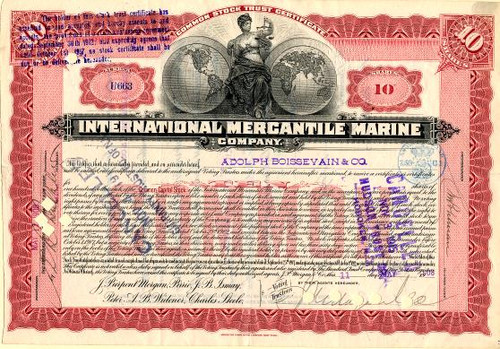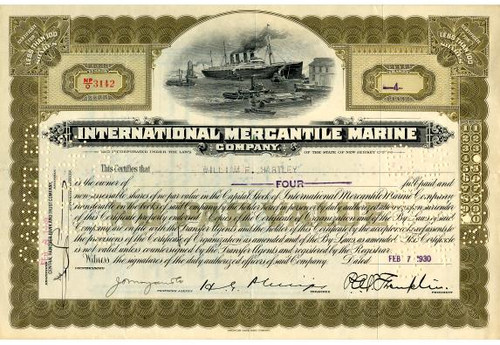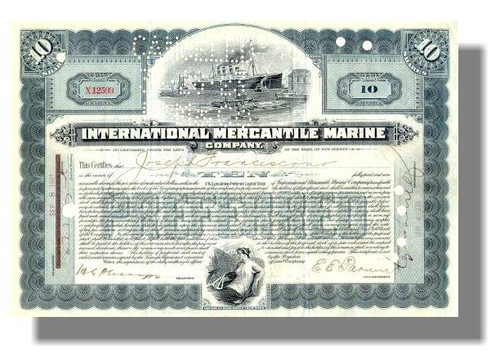

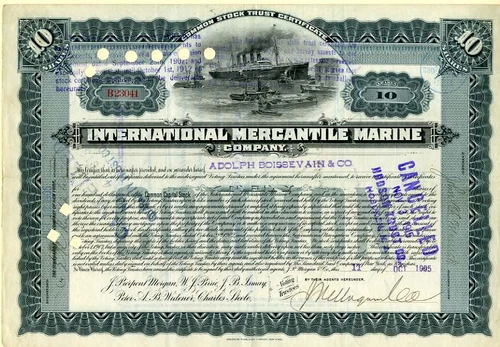
Stock printed by American Bank Note Company, New York. The certificate was issued to Adolph Boissevain & Co.
Adolphe Boissevain founded the firm in 1875 in Amsterdam. His early assistant and later partner was J.L. Pierson. The town of Boissevain, Manitoba, in Canada is named in honor of Adolphe Boissevain for his financial backing of the Canadian Pacific Railway
The International Mercantile Marine Company, originally the International Navigation Company, was a trust formed in the early twentieth century as an attempt by J.P. Morgan to monopolize the shipping trade.
IMM was founded by shipping magnates Clement Griscom of the American Line and Red Star Line, Bernard N. Baker of the Atlantic Transport Line, J. Bruce Ismay of the White Star Line, and John Ellerman of the Leyland Line. The Dominion Line was also amalgamated. The project was bankrolled by J.P. Morgan & Co., led by financier J. P. Morgan. The company also had working profit-sharing relationships with the German Hamburg-Amerika and the North German Lloyd lines. The trust caused great concern in the British shipping industry and led directly to the British government's subsidy of the Cunard Line's new ships RMS Lusitania and RMS Mauretania in an effort to compete.
IMM was a holding company that controlled subsidiary corporations that had their own subsidiaries. Morgan hoped to dominate transatlantic shipping through interlocking directorates and contractual arrangements with the railroads, but that proved impossible because of the nature of sea transport, American antitrust legislation, and an agreement with the British government. One of IMM's subsidiaries was the White Star Line, which owned the RMS Titanic. Analysis of financial records shows that IMM was overleveraged and suffered from inadequate cash flow that caused it to default on bond interest payments in late 1914. As a result, a "friendly" receivership was put in effect in 1915, which allowed IMM to reorganize its finances; it emerged from the receivership in 1916.[1] Saved by World War I, IMM eventually re-emerged, after a merger with Roosevelt Steamship Company, as the United States Lines, which itself went bankrupt in 1986.[2]
A proposed subsidy bill in the United States Congress failed, which became widely apparent by April 1902 [a] and the company thus was never truly successful. Beginning in the 1920s, the company underwent a series of corporate acquisitions and mergers, which resulted in its becoming the United States Lines in 1943.
Voting Trustees listed at bottom left of the certificate:

John Pierpont Morgan Sr. (April 17, 1837 – March 31, 1913) was an American financier and investment banker who dominated corporate finance on Wall Street throughout the Gilded Age. As the head of the banking firm that ultimately became known as J.P. Morgan and Co., he was the driving force behind the wave of industrial consolidation in the United States spanning the late 19th and early 20th centuries.
Over the course of his career on Wall Street, J.P. Morgan spearheaded the formation of several prominent multinational corporations including U.S. Steel, International Harvester and General Electric which subsequently fell under his supervision. He and his partners also held controlling interests in numerous other American businesses including Aetna, Western Union, Pullman Car Company and 21 railroads. Due to the extent of his dominance over U.S. finance, Morgan exercised enormous influence over the nation's policies and the market forces underlying its economy. During the Panic of 1907, he organized a coalition of financiers that saved the American monetary system from collapse.
As the Progressive Era's leading financier, J.P. Morgan's dedication to efficiency and modernization helped transform the shape of the American economy. Adrian Wooldridge characterized Morgan as America's "greatest banker". Morgan died in Rome, Italy, in his sleep in 1913 at the age of 75, leaving his fortune and business to his son, John Pierpont Morgan Jr. Biographer Ron Chernow estimated his fortune at $80 million (equivalent to $2.2 billion in 2021).
William James Pirrie, 1st Viscount Pirrie, KP, PC, PC (Ire) (31 May 1847 – 7 June 1924) was a leading British shipbuilder and businessman. He was chairman of Harland and Wolff, shipbuilders, between 1895 and 1924, and also served as Lord Mayor of Belfast between 1896 and 1898. He was ennobled as Baron Pirrie in 1906, appointed a Knight of the Order of St Patrick in 1908 and made Viscount Pirrie in 1921. In the months leading up to the 1912 Titanic disaster, Lord Pirrie was questioned about the number of life boats aboard the Olympic-class ships. He responded that the great ships were unsinkable and the rafts were to save others. This would haunt him forever. In Belfast he was, on other grounds, already a controversial figure: a Protestant employer associated as a leading Liberal with a policy of Home Rule for Ireland.
Joseph Bruce Ismay 12 December 1862 – 17 October 1937) was an English businessman who served as chairman and managing director of the White Star Line. In 1912, he came to international attention as the highest-ranking White Star official to survive the sinking of the company's new flagship RMS Titanic, for which he was subject to severe criticism.
Peter Arrell Browne Widener (November 13, 1834 – November 6, 1915) was an American businessman, art collector, and patriarch of the Widener family of Philadelphia, Pennsylvania. Widener was ranked #29 on the American Heritage list of the forty richest Americans in history, with a net worth at death of $23 billion to $25 billion (in 1998 dollars).
Charles Steele (May 5, 1858 – August 5, 1939) was an American lawyer and philanthropist who was a member of J.P. Morgan & Co. for 39 years.